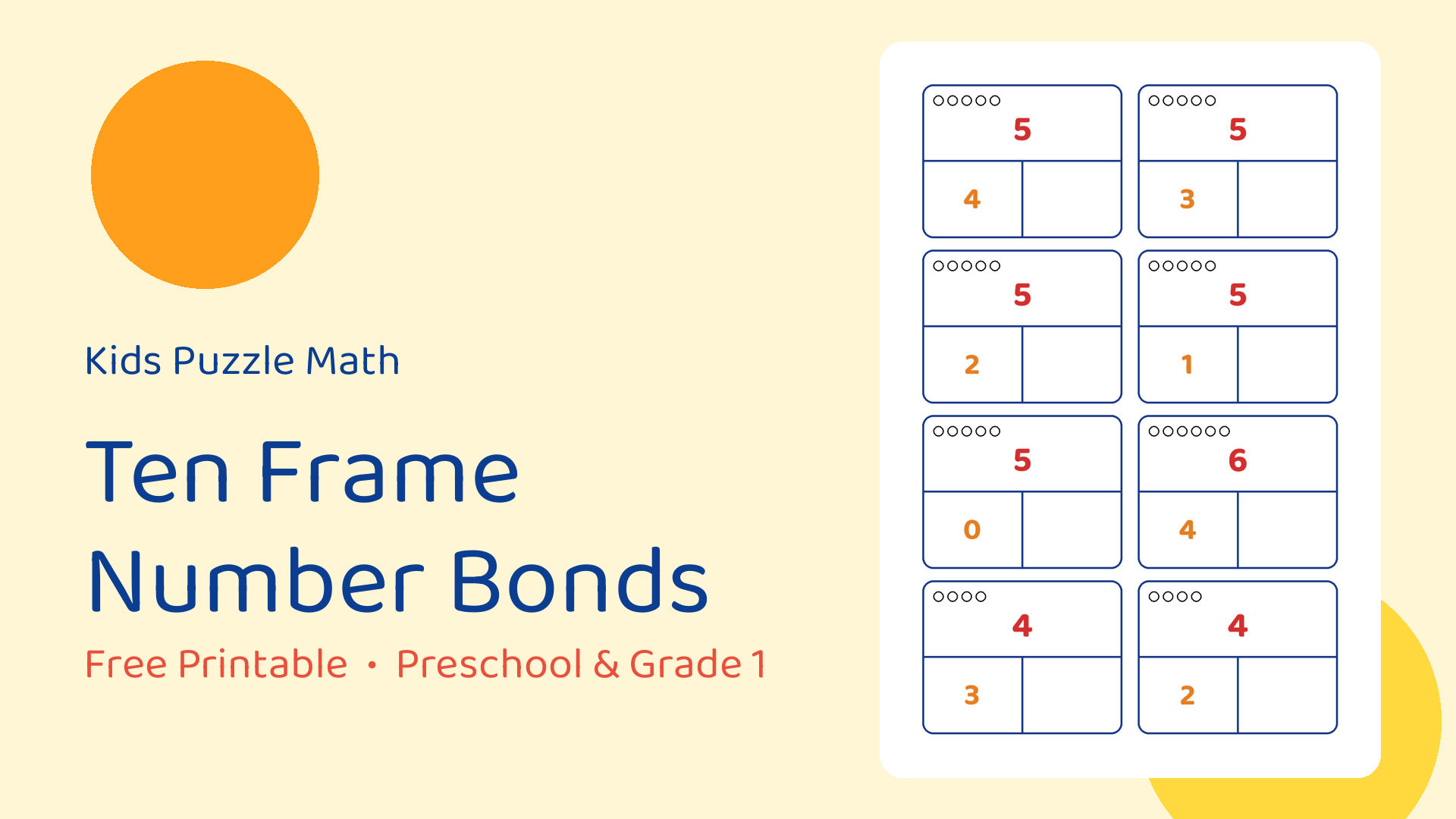
Some mornings, five minutes with a ten frame is all it takes to settle a wiggly mathematician down. That is exactly why I love ten frame number bonds: the dots do the explaining, and your child gets to do the thinking.
This post now holds six free printables in one place. The main sheet is number bonds to 6, and it is the gentle place to start. The five extra sheets are ten frame addition to 10 practice, so you can move on when your child is ready for a bigger total.
Print one sheet, grab a pencil, and let your child count out loud. There is no rush, and there is no need to finish all six in one sitting.
Download Worksheet (Free Printable)
Ten Frame Number Bonds to 6: What Is on the Main Sheet?
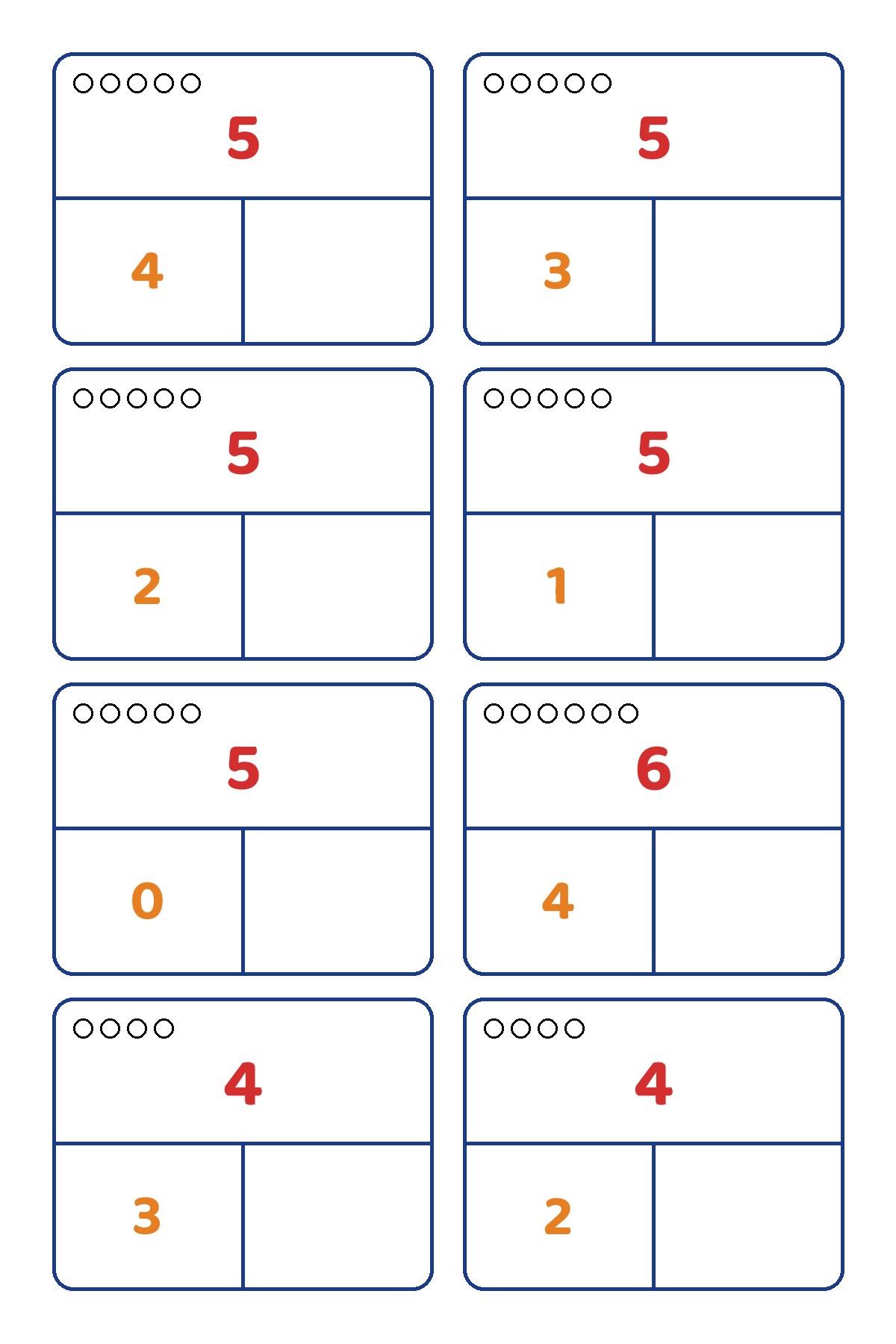
The main sheet has eight little boxes, arranged in two columns. Each box has a big red number at the top, one orange number underneath, and one empty box waiting for an answer.
The big numbers are 5, 5, 5, 5, 5, 6, 4 and 4. The orange numbers underneath are 4, 3, 2, 1, 0, 4, 3 and 2. Your child has to find the missing part that makes the whole.
Look at the first box as an example. The whole is 5 and one part is 4, so the missing part is 1. The little circles in the corner of each box match the big number, which gives a quiet clue if your child gets stuck.
Tip for parents and teachers: ask your child to say the whole bond out loud, such as “4 and 1 make 5”. Hearing the pair together helps it stick far better than just writing a number down.
Five Extra Sheets: Ten Frame Addition to 10
Once bonds to 6 feel comfortable, these five extra sheets stretch the same idea up to 10. Every sheet has eight ten frames, each one a two-row grid of ten boxes with black dots inside.
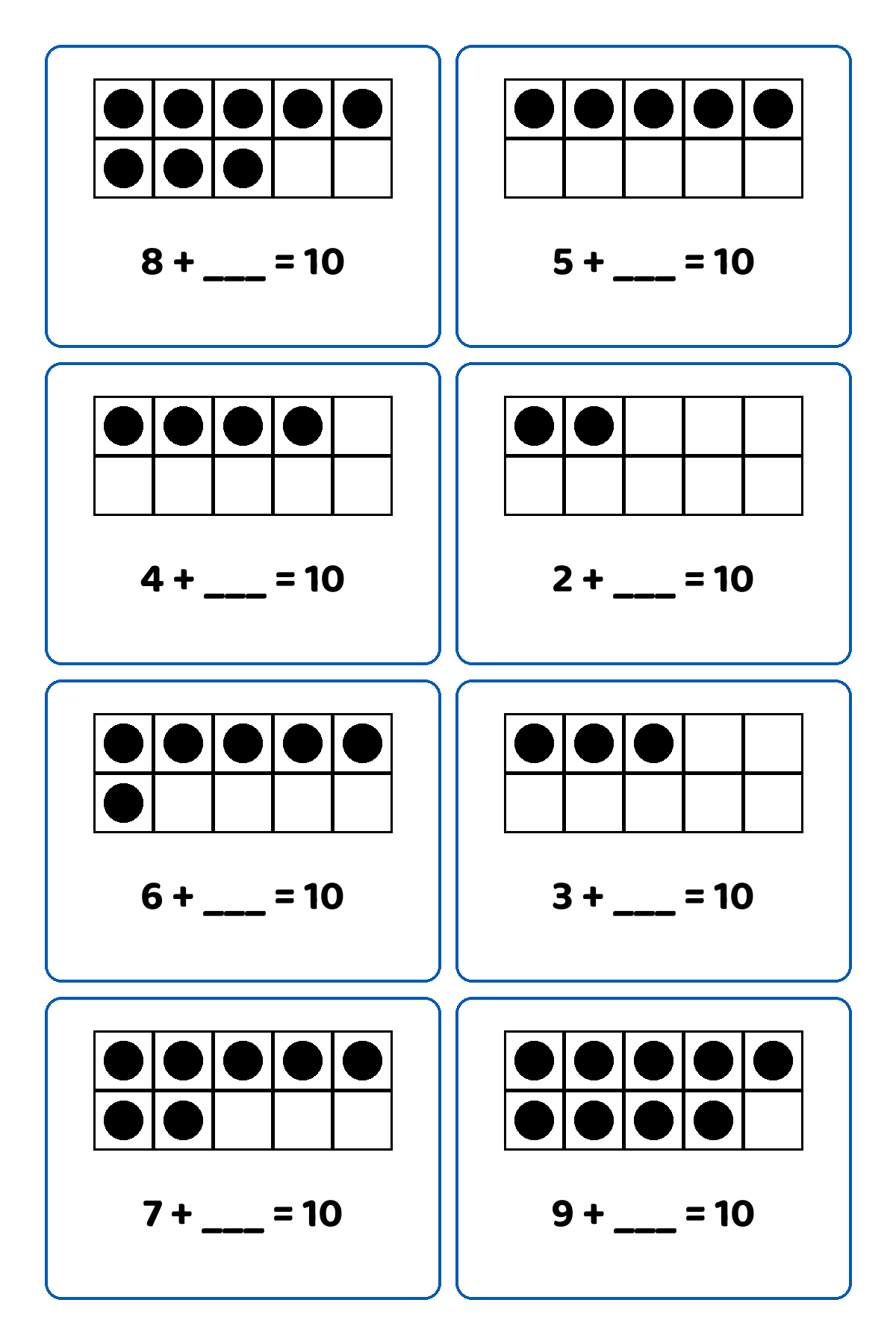
Under each frame there is a sum to finish, such as 8 + __ = 10. Your child counts the dots, then counts the empty boxes to find how many more are needed to reach 10.
All five sheets use the same starting numbers — 2, 3, 4, 5, 6, 7, 8 and 9 — but in a different order each time. That means your child cannot just copy yesterday’s answers. They have to look, count and think again.
Sheet 1 — It Starts With 8 + __ = 10
This first extra sheet opens with a nearly full ten frame. There are 8 black dots, with just 2 empty boxes left, so the answer is 2.
After that it goes 5 + __ = 10, 4 + __ = 10, 2 + __ = 10, 6 + __ = 10, 3 + __ = 10, 7 + __ = 10 and 9 + __ = 10. The missing numbers, in order, are 2, 5, 6, 8, 4, 7, 3 and 1.
Tip: if your child is unsure, get them to count the empty boxes first. The empty spaces are the answer, and spotting them is often quicker than counting up from the dots.
Download Sheet 1 (Free Printable)
Sheet 2 — It Starts With 9 + __ = 10
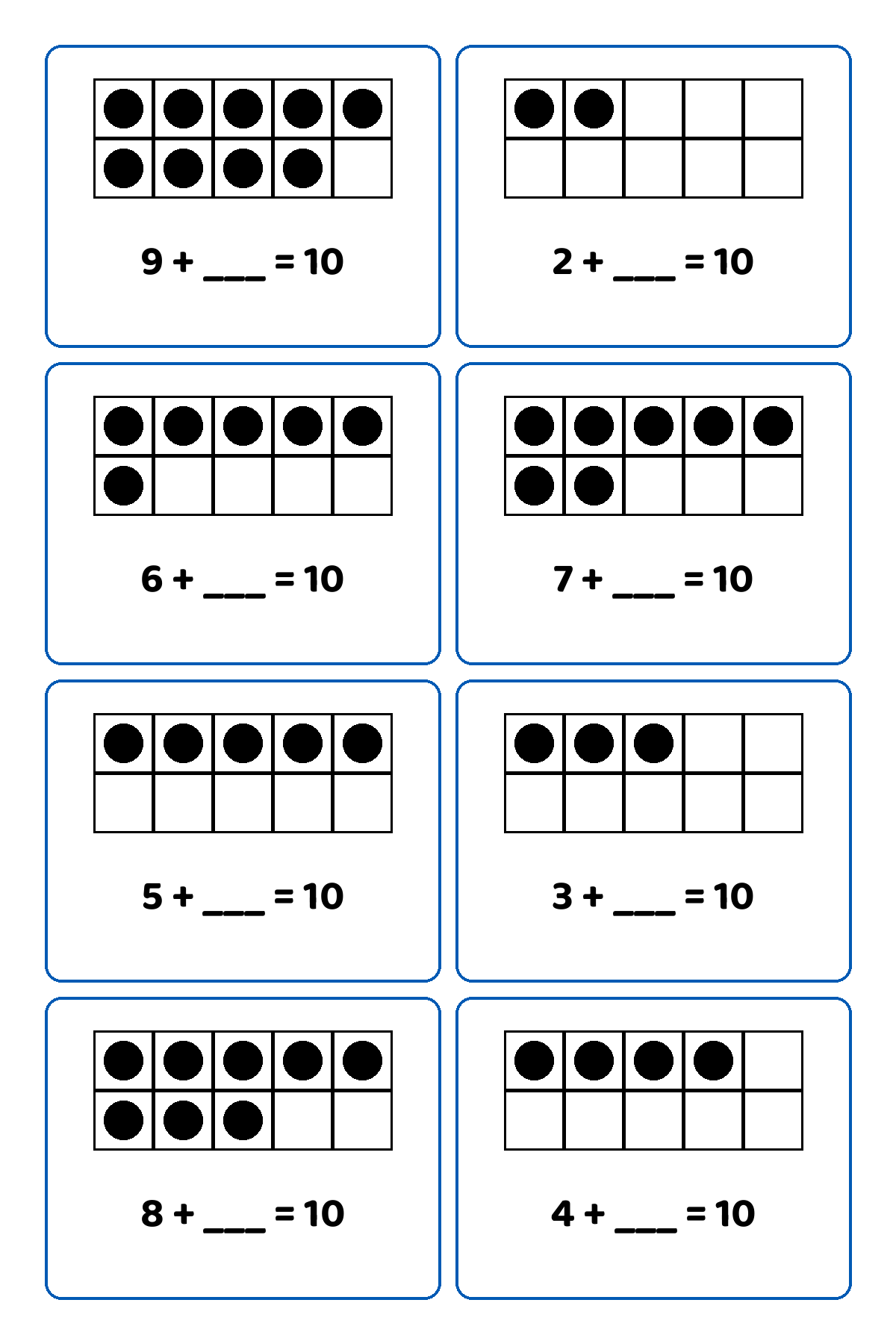
Sheet 2 begins with the trickiest-looking one: a ten frame with 9 dots and only one empty box. The answer is just 1, which is a lovely confidence boost.
It then moves to 2 + __ = 10, 6 + __ = 10, 7 + __ = 10, 5 + __ = 10, 3 + __ = 10, 8 + __ = 10 and 4 + __ = 10. The missing numbers, in order, are 1, 8, 4, 3, 5, 7, 2 and 6.
Tip: point out the pair 9 and 1, then 1 and 9, on different days. Seeing that a bond works both ways round is a big step towards real number sense.
Download Sheet 2 (Free Printable)
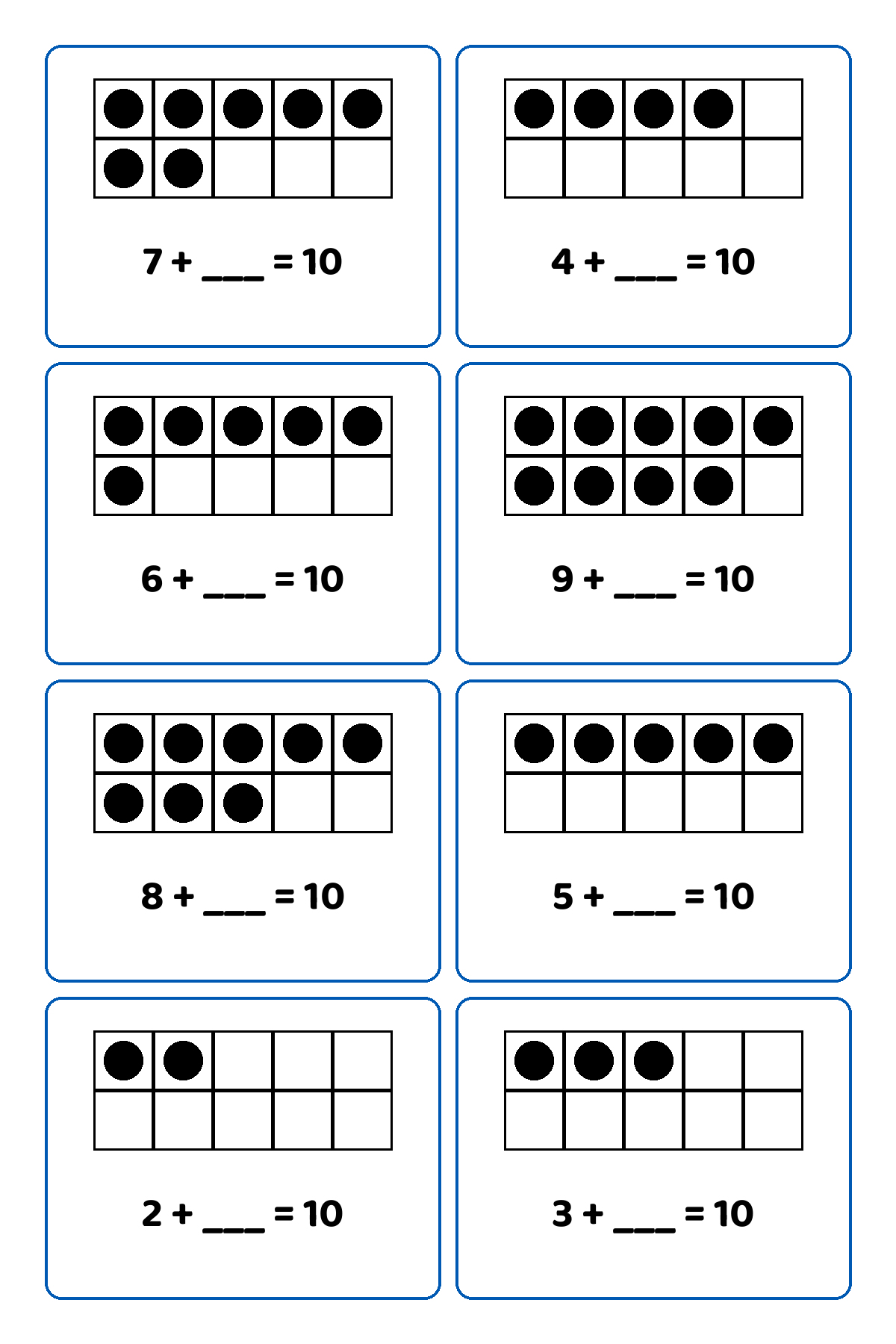
Sheet 3 — It Starts With 7 + __ = 10
Sheet 3 opens in the middle of the range, with 7 dots filling the top row and two more in the bottom row. Three boxes are empty, so the missing number is 3.
Next come 4 + __ = 10, 6 + __ = 10, 9 + __ = 10, 8 + __ = 10, 5 + __ = 10, 2 + __ = 10 and 3 + __ = 10. The missing numbers, in order, are 3, 6, 4, 1, 2, 5, 8 and 7.
Tip: this is a good sheet for the “five and a bit” idea. Ask your child to spot the full top row of five first, then count the extra dots. It turns 7 into 5 and 2, which is much easier to hold in your head.
Download Sheet 3 (Free Printable)
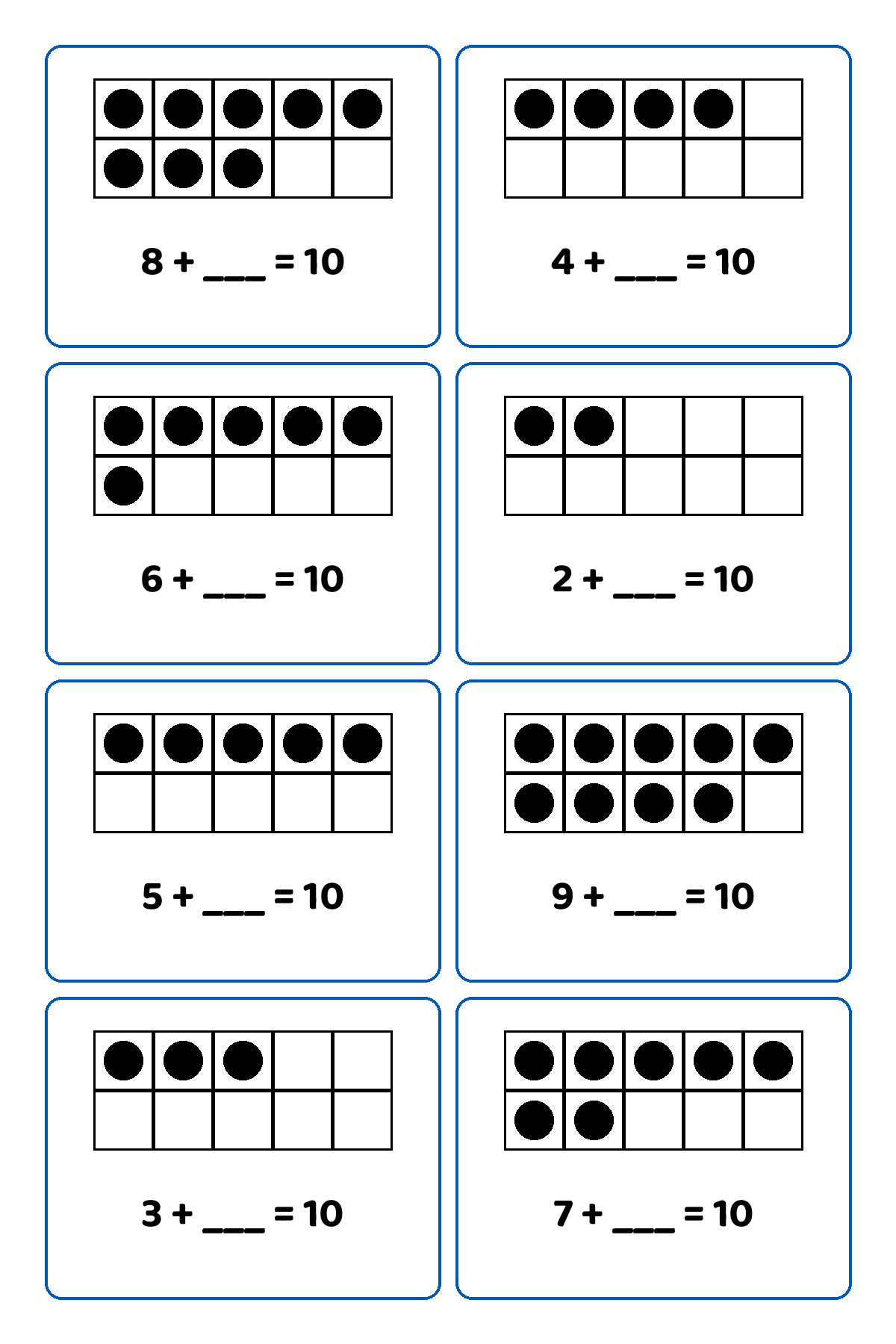
Sheet 4 — It Starts With 8, Then Jumps to 4
Sheet 4 looks a lot like Sheet 1 at first glance, because it also opens with 8 dots. The second box is the giveaway: this time it is 4 dots, not 5.
The full order is 8 + __ = 10, 4 + __ = 10, 6 + __ = 10, 2 + __ = 10, 5 + __ = 10, 9 + __ = 10, 3 + __ = 10 and 7 + __ = 10. The missing numbers, in order, are 2, 6, 4, 8, 5, 1, 7 and 3.
Tip: keep this sheet for a second day of practice. Your child will feel clever for recognising the 8, then still have to slow down and check the rest. That mix of familiar and new is perfect for practice.
Download Sheet 4 (Free Printable)
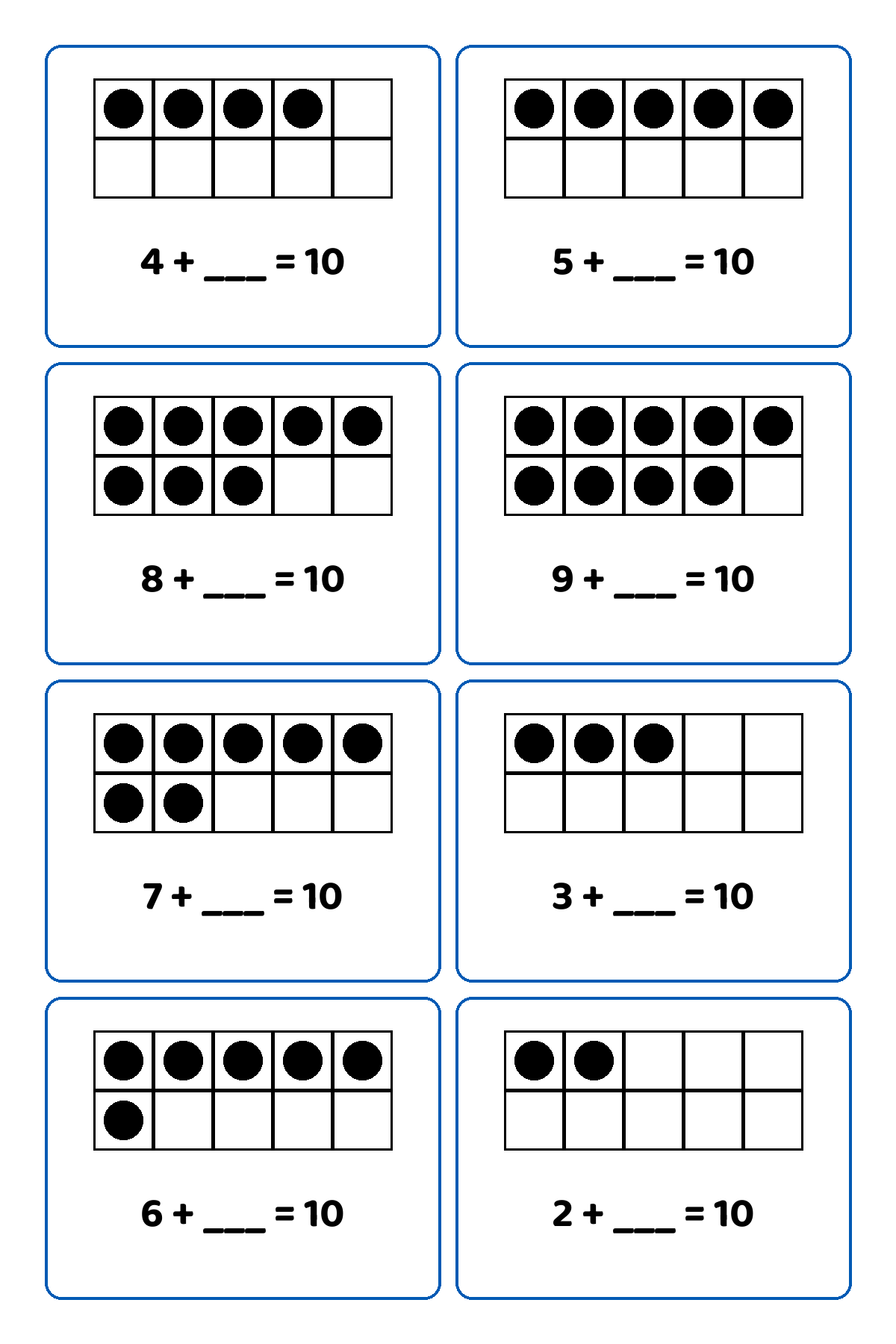
Sheet 5 — It Starts With the Small Numbers, 4 and 5
Sheet 5 is the gentlest of the five extra sheets to start. It opens with just 4 dots, then 5 dots, so your child can warm up before the bigger frames appear.
After those come 8 + __ = 10, 9 + __ = 10, 7 + __ = 10, 3 + __ = 10, 6 + __ = 10 and 2 + __ = 10. The missing numbers, in order, are 6, 5, 2, 1, 3, 7, 4 and 8.
Tip: use this sheet first if your child is new to ten frames. The 5-dot frame is exactly half full, which is a lovely anchor — half of 10 is 5, so 5 and 5 make 10.
Download Sheet 5 (Free Printable)
How to Use the Six Sheets Across a Week
You do not need a lesson plan for these. One sheet a day, for about ten minutes, works really well for most families.
Start the week with the main sheet, the bonds to 6. Then try one addition-to-10 sheet each day after that. If a sheet feels hard, just repeat it the next day — the shuffled order means it will still feel fresh.
Let your child use counters, fingers or little buttons on the ten frame if that helps. The aim is understanding, not speed, and hands-on counting is part of the learning.
Who Will Enjoy These Sheets Most?
These sheets are made for preschool and kindergarten children, roughly ages 4 to 6. They suit a classroom maths corner, a homeschool morning, or a quiet activity at the kitchen table.
They also work well for a child who can already count to 10 but still needs to see what the numbers mean. The dots give them something real to count, instead of a bare sum on a page.
If your child finishes all six and wants more, try the same bonds with real objects — six grapes, ten building bricks, or ten fingers and toes. The maths is the same; only the props change.
How to Print and Download
Click any worksheet image above to open it at full size, then print it from your browser. Each image is a clear, print-friendly PNG, and all six are under 200 KB, so they download quickly.
For the best result, print on A4 or US Letter paper at 100% scale. A black-and-white print works just fine — the dots and numbers are bold and easy to read.
Save the files to print them again later, and keep a finished sheet in a folder. In a few weeks, you will be able to look back and see just how much quicker those bonds to 6 and to 10 have become.
1 thought on “Ten Frame Number Bonds Worksheet | Addition to 6 | Kindergarten Math Printable”